
Why Feeding Your Family Well Costs More Than It Should (And What to Do About It)
Family healthy meals on a budget is one of the biggest challenges facing households right now. Food-at-home prices have risen roughly 25% since 2020, and the USDA’s lowest-cost estimate for feeding a family of four now tops $1,000 per month.
Here’s a quick overview of the most effective ways to eat healthy as a family without overspending:
| Strategy | Potential Weekly Savings |
|---|---|
| Stick to a grocery list | $20–$40 |
| Two vegetarian dinners per week | $6–$12 |
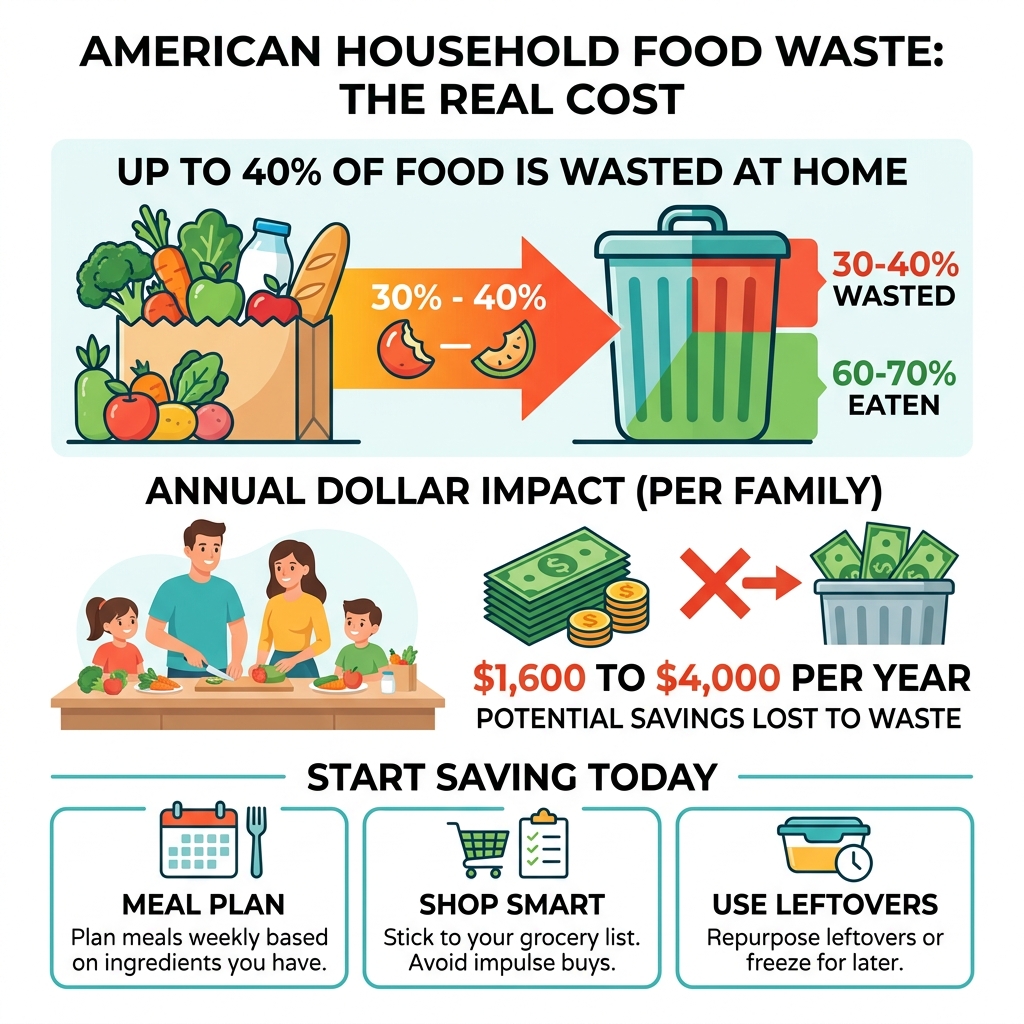
| Cut food waste from 30–40% to under 10% | $40–$60 |
| Buy in-season or frozen produce | 30–50% on produce costs |
| Anchor meals to cheap staples (rice, beans, eggs) | $0.10–$0.30 per serving |
The good news? A well-planned home-cooked meal averages just $2–$4 per serving — two to three times cheaper than meal kit services.
The bad news? Most families are unknowingly throwing away a huge chunk of their grocery budget every single week — not at the store, but at home. The average household wastes 30–40% of the food it buys. For a family spending $200 a week on groceries, that’s up to $4,000 a year in the trash.
The fix isn’t extreme couponing or buying food you hate. It’s smarter planning — knowing which ingredients to buy, how to use them across multiple meals, and which shortcuts actually save money without sacrificing nutrition.
This guide breaks down the best practical solutions for getting healthy food on the table every night, without the stress or the overspending.
Strategic Meal Planning: The #1 Tool for Family Healthy Meals on a Budget
If we want to stop the financial leak in our kitchens, we have to talk about meal planning. It isn’t just about knowing what’s for dinner on Tuesday; it’s the highest-leverage tool we have to fight inflation. When we go to the store without a plan, we are essentially browsing, and browsing is where the “impulse buy” demons live. Sticking to a strict grocery list can save the average family $20 to $40 per week.

The most effective way to plan family healthy meals on a budget is to look at our kitchen as an ecosystem rather than a series of isolated events. We often fall into the trap of buying a specific set of ingredients for one recipe, using half of them, and letting the rest wilt in the crisper drawer. This is why we advocate for “ingredient overlap.”
| Metric | Meal Planning | No Planning (Impulse) |
|---|---|---|
| Cost per serving | $2.00 – $4.00 | $8.00 – $15.00 |
| Food Waste | < 10% | 30% – 40% |
| Nutrition | Controlled & Balanced | High Sodium/Processed |
| Stress Level | Low (Pre-decided) | High (5 PM Panic) |
By planning meals that share core ingredients, we create an “ingredient web.” This reduces the number of items we need to buy and ensures that every head of cabbage or bag of spinach actually gets eaten. For more detailed strategies, check out our guide on budget-friendly meal prep ideas for the family.
Building an Ingredient Web for Family Healthy Meals on a Budget
The concept of the “ingredient web” is simple: buy once, eat three times. Instead of buying individual chicken breasts for one night, we might buy a whole chicken or a large pack of thighs.
For example, a Sunday roast chicken can provide:
- Sunday Night: Traditional roast chicken with potatoes and carrots.
- Tuesday Night: Shredded chicken tacos or quesadillas using the leftover meat.
- Thursday Night: A hearty chicken and vegetable soup made from the remaining scraps and a broth simmered from the bones.
This cross-utilization isn’t just “eating leftovers”—it’s strategic batch cooking. It allows us to buy in bulk, which is almost always cheaper, and eliminates the “what’s in the fridge?” mystery that leads to expensive takeout orders. You can find more tips for eating healthy on a budget to help refine your shopping list.
The 30-Minute Rule for Busy Weeknights
We know the reality: if a healthy meal takes two hours to prep after a long day of work and school, it’s probably not going to happen. The “30-minute rule” is essential for staying on track. We prioritize one-pan meals, sheet-pan dinners, and slow-cooker recipes that do the heavy lifting for us.
Sheet-pan fajitas or a Cajun cabbage skillet are excellent examples. They require minimal prep and even less cleanup. Slow cookers are also a budget family’s best friend; you can throw in cheap cuts of meat or dried beans in the morning and come home to a nutrient-dense stew. We’ve curated a list of healthy family meals that won’t take all evening to prepare to keep your weeknights stress-free.
Top 5 Budget-Friendly Protein Solutions for Healthy Dinners
Protein usually accounts for 40 to 50 percent of a grocery bill. If we can optimize our protein spending, we’ve won half the battle. The secret is moving down the “protein cost hierarchy.” While a ribeye steak might cost $10 per serving, lentils and beans cost between $0.25 and $0.50 per serving.
Incorporating just two vegetarian nights per week can save a family of four roughly $6 to $12 weekly, which adds up to over $600 a year. This doesn’t mean we have to give up meat entirely; it just means we treat it as an accent rather than the main event. For more on balancing these nutrients, see our article on healthy eating for families.
Cost-Effective Pantry Staples for Family Healthy Meals on a Budget
Every budget-conscious kitchen needs a “survival kit” of staples. These items have a long shelf life and cost approximately $0.10 to $0.30 per serving:
- Dried Beans and Lentils: The undisputed kings of budget nutrition. They are packed with fiber and protein.
- Brown Rice and Quinoa: Great for “bulking out” meals and providing long-lasting energy.
- Oats: Not just for breakfast! They can be used as a binder in meatloaf or added to smoothies.
- Whole-Wheat Pasta: A quick, filling base for any vegetable-heavy sauce.
- Canned Tuna or Sardines: Excellent shelf-stable sources of Omega-3s.
- Eggs: At roughly $0.20–$0.40 per egg (even with price spikes), they remain one of the cheapest high-quality proteins available.
Smart Meat Swaps and Stretching Techniques
When we do buy meat, we choose the “smart” cuts. Chicken thighs are often half the price of breasts and have more flavor. Pork shoulder is an incredibly affordable cut that can be slow-cooked into pulled pork for sandwiches, tacos, or grain bowls.
Another pro tip: stretch your meat. If a recipe calls for a pound of ground beef, use half a pound and “beef it up” with a can of black beans or a cup of cooked lentils. Your family likely won’t notice the difference in a chili or taco filling, but your wallet certainly will. Check out these quick meal ideas for families for more inspiration on making meat go further.
Smart Shopping Hacks: Seasonal Produce and Frozen Staples
Fresh isn’t always best—at least not for your bank account. In-season produce is 30 to 50 percent cheaper than out-of-season items. Buying strawberries in June is a bargain; buying them in December is a luxury.
However, the real “cheat code” for family healthy meals on a budget is the freezer aisle. Research shows that frozen fruits and vegetables are nutritionally equivalent—and sometimes even superior—to fresh produce because they are picked and frozen at peak ripeness.
- Frozen Spinach: A lifesaver for soups, smoothies, and pasta sauces.
- Frozen Berries: Perfect for oatmeal or yogurt without the $7 fresh price tag.
- Frozen Peas and Corn: Easy sides that kids actually enjoy.
By switching to store brands for these frozen staples, we can save significantly without any loss in quality. For more ideas on using these staples, see our quick meal ideas for families-2.
How to Manage Picky Eaters Without Breaking the Bank
We’ve all been there: you spend forty minutes cooking a healthy, budget-friendly meal, only for your toddler to look at it like it’s a plate of rocks. The temptation is to become a “short-order cook” and make a separate meal, but that destroys the budget and increases waste.
The solution is deconstructed meals. Instead of serving a mixed salad or a pre-assembled taco, serve the components separately. This allows the “picky” eater to choose their “safe” foods (like plain chicken and rice) while still being exposed to the “scary” foods (like peppers or beans) on the same table.
Remember the 10-15 exposures rule: children often need to see a new food ten or more times before they are willing to try it. Don’t stop buying the broccoli; just keep serving it in small, low-pressure portions. We have a great resource on kid-friendly meal prep recipes everyone will love that uses this philosophy.
Budget-Friendly Snacks and Lunchbox Solutions
Snack time is where the budget often goes to die. Pre-packaged “kid snacks” are essentially expensive plastic and sugar. We can save a fortune by making our own:
- Bulk Popcorn: Buy the kernels, pop them on the stove, and season with a little olive oil and salt.
- Seasonal Fruit: An apple or a banana is significantly cheaper than a fruit leather or a processed fruit cup.
- Homemade Granola Bars: Using those oats we mentioned earlier!
For the school run, try curating the ultimate teen-approved packed lunch or check out these easy snack ideas for kids to keep the “hangry” meltdowns at bay without hitting the vending machine.
Frequently Asked Questions about Family Healthy Meals on a Budget
Can you really feed a family of 4 for $100 per week?
Yes, but it requires discipline and a shift in how we shop. In 2026, a $100 weekly budget means anchoring almost every meal to cheap staples like rice, beans, pasta, and potatoes. It involves cooking 5–6 nights a week, eliminating sugary drinks, and buying only what is on the list. A typical breakdown might look like $50 for dinners (planned around sales), $30 for breakfast and lunch staples (eggs, oats, bread, peanut butter), and $20 for seasonal produce and snacks.
What are the cheapest healthy protein sources?
Lentils are the champion, costing pennies per serving. Eggs are a close second. Canned sardines or mackerel provide high-quality protein and healthy fats for very little money. Dried chickpeas are incredibly versatile (think homemade hummus or roasted snacks), and chicken drumsticks are frequently the most affordable meat option at the butcher counter.
How do I reduce food waste to save money?
Start with a “fridge audit” before you go shopping. See what needs to be used up and plan your first two meals of the week around those items. Implement an “Eat Me First” bin in the fridge for items nearing their expiration. Also, learn to love your freezer; if you have half an onion or a handful of spinach left, freeze it for a future soup or stir-fry instead of letting it rot.
Conclusion
At Quintal Florido, we believe that eating well shouldn’t be a privilege reserved for the wealthy. By using evidence-based nutrition strategies and a bit of “kitchen logic,” we can provide our families with a balanced, wholesome diet that supports long-term health. It’s not about being perfect; it’s about making smarter choices, one grocery trip at a time.
Ready to take the next step? Start your journey with healthy eating for families and discover how simple, affordable changes can lead to a lifetime of better health for you and your loved ones.
