
Why Balanced Diet Ideas Matter More Than You Think
Balanced diet ideas don’t have to be complicated — here are the core principles to get started right away:
- Fill half your plate with fruits and vegetables (non-starchy, varied colors)
- Fill a quarter with whole grains like brown rice, oats, or quinoa
- Fill the last quarter with lean protein — chicken, fish, eggs, beans, or nuts
- Add low-fat dairy or a fortified alternative on the side (about 3 cups daily)
- Limit added sugars, saturated fats, and sodium as much as possible
- Drink at least 6 to 8 glasses of water daily
That’s the short version. Now here’s why it actually matters.
Most people know they should eat better. But between work, family, and a packed schedule, it’s easy to fall into patterns of grabbing whatever’s quick — and that usually means too many calories, too much salt, and not enough of the good stuff.
The data backs this up. Most UK adults are overweight or obese. The average American takes in over 3,400 mg of sodium daily — well above the recommended 2,300 mg limit. And research consistently shows that most people eat far too little fruit, vegetables, oily fish, and fibre.
The good news? You don’t need a perfect diet. Small, consistent changes to what’s on your plate can meaningfully reduce your risk of heart disease, type 2 diabetes, and other chronic conditions. Men who scored highest on a major healthy eating index reduced their cardiovascular disease risk by nearly 40%. Women saw close to a 30% reduction.
This guide breaks down exactly what a balanced diet looks like — and how to make it work in real life, even when you’re busy.
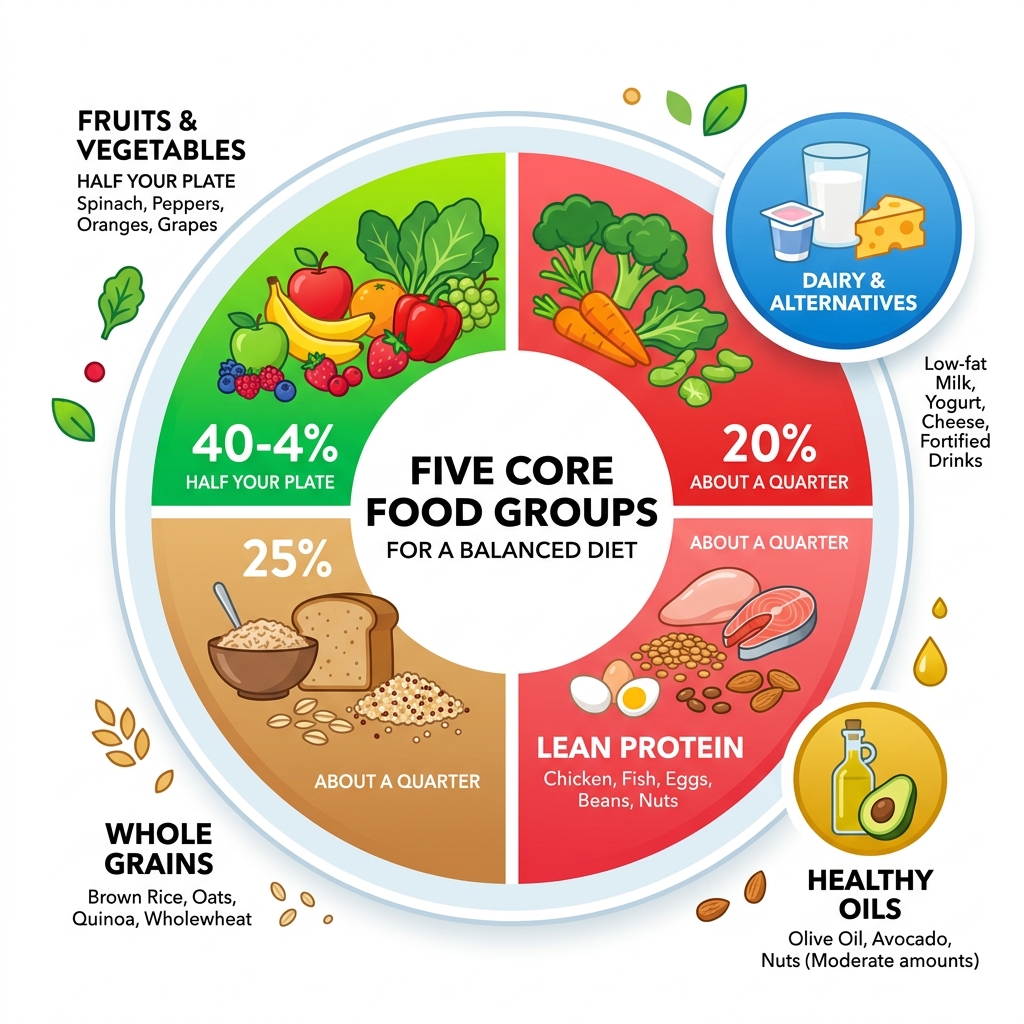
Core Principles of Balanced Diet Ideas
When we talk about balanced diet ideas, we are really talking about providing our bodies with the right fuel in the right proportions. It isn’t about deprivation or living on celery sticks; it’s about variety. Think of your body like a high-performance engine. If you only give it one type of fuel (like sugar) and ignore the oil and coolant (like vitamins and minerals), things are going to start smoking under the hood pretty quickly.
Two major models guide our understanding of a healthy plate: the USDA’s MyPlate and the Harvard Healthy Eating Plate. Both move away from the old-fashioned “food pyramid” and toward a visual representation of what a single meal should look like. In the UK, the Eatwell Guide provides a similar framework, emphasizing that starchy carbohydrates and fruits/vegetables should each make up just over a third of what we eat.
The goal is nutrient density. This means choosing foods that pack a lot of vitamins, minerals, and fiber for relatively few calories. For instance, a handful of kale is nutrient-dense, while a handful of jellybeans is “energy-dense” (lots of calories, zero nutrition). To find out exactly how many calories your specific body needs based on your age, height, and activity level, you can use the MyPlate Plan for personalized calorie needs.
If you are just starting out, don’t feel like you have to overhaul your kitchen overnight. We recommend checking out our balanced diet plan for beginners to ease into these habits.
Understanding the Plate Method
The plate method is perhaps the most powerful tool in our nutrition arsenal because it requires no scales or complex math.
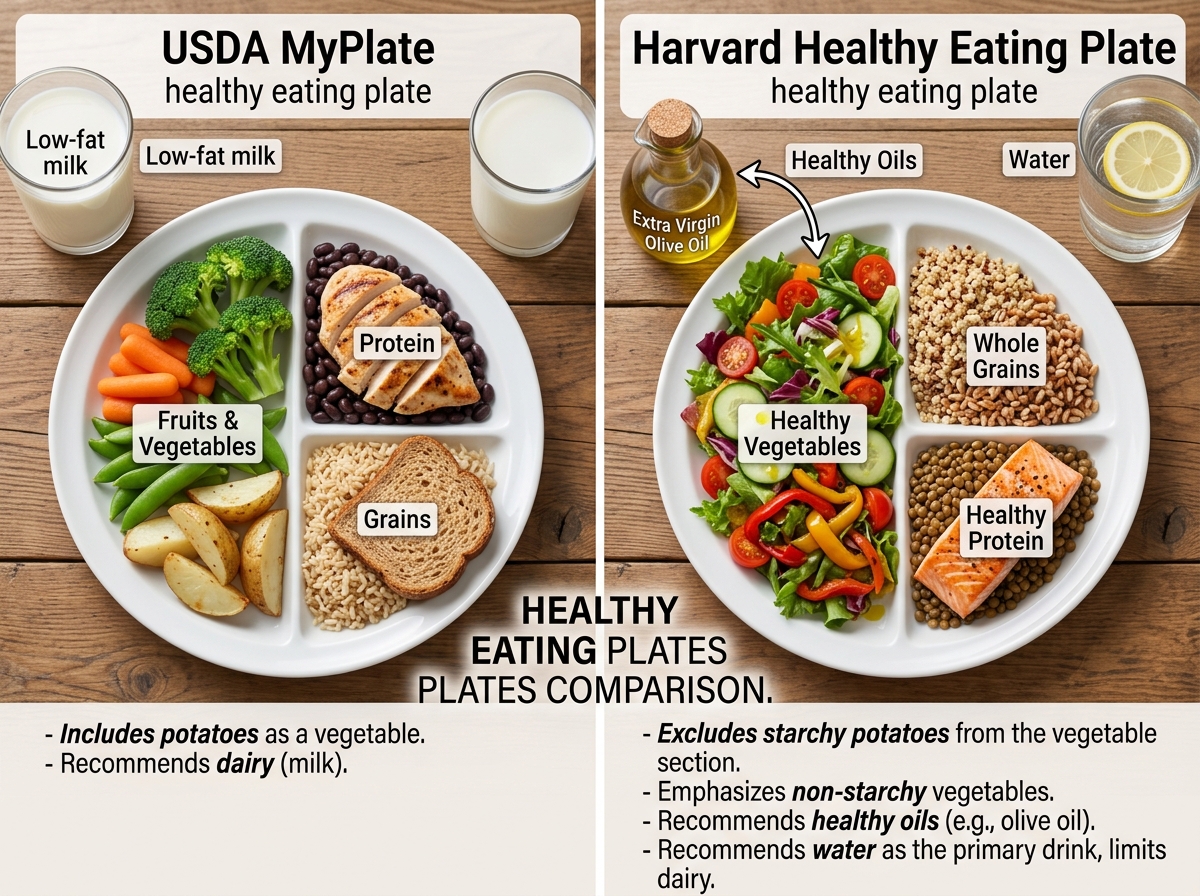
While the USDA MyPlate is a fantastic baseline, the Harvard Healthy Eating Plate offers a few “pro” tweaks based on the latest science:
- The Veggie Rule: Half your plate should be produce, but Harvard specifies that potatoes and French fries don’t count as vegetables because they have a high impact on blood sugar.
- The Grain Quality: A quarter of your plate should be grains, but the emphasis is strictly on whole grains.
- Healthy Oils: Unlike federal guidelines that often shy away from fats, the Harvard model encourages healthy plant oils (like olive or canola) and notes that “low-fat” isn’t always better if the fat is replaced by refined carbs.
Following these proportional eating habits is scientifically proven to save lives. Scientific research on diet quality and cardiovascular risk indicates that those who adhere to these plate-based principles have significantly lower rates of chronic disease.
Incorporating Fruits and Vegetables into Your Balanced Diet Ideas
We’ve all heard of “5 A Day,” but what does that actually look like on a Tuesday afternoon? In the UK, a portion is generally defined as 80g of fresh, canned, or frozen produce. To give you a visual:
- 1 medium apple or banana.
- 3 heaped tablespoons of cooked vegetables.
- 1 large slice of melon or pineapple.
Variety is the secret sauce here. Different colors in plants represent different phytochemicals—natural compounds that help fight inflammation and cancer. If you only eat green beans, you’re missing out on the lycopene in tomatoes or the anthocyanins in blueberries.
A common question we get is: “Does fruit juice count?” Yes, but only as one of your five portions, and it should be limited to 150ml. Juice lacks the fiber of whole fruit and can lead to sugar spikes. If you’re looking to strip back the processed gunk and get back to basics, our clean eating tips for beginners can help you navigate the produce aisle like a pro.
The Five Pillars of a Nutritious Meal Plan
A truly balanced meal plan rests on five pillars: whole grains, lean proteins, healthy fats, dairy (or alternatives), and a mountain of produce. Balancing these ensures you get the right mix of macronutrients (carbs, protein, fats) and micronutrients (vitamins and minerals).
When we approach meal planning for nutrition, we focus on “crowding out.” Instead of saying “I can’t eat bread,” we say “I’m going to fill my plate with so much good stuff that there’s only room for a sensible portion of whole-grain bread.”
Whole Grains and Starchy Carbohydrates
Carbs are not the enemy! They are our body’s preferred energy source. However, the type of carb matters immensely. Whole grains—like quinoa, brown rice, barley, and oats—contain the entire grain kernel (the bran, germ, and endosperm). This means they take longer to digest, keeping you fuller for longer and preventing the “energy crash” associated with white bread or sugary cereals.
Starchy foods should make up about a third of your intake. Whenever possible, keep the skins on your potatoes for extra fiber. For a deep dive into why the bran and germ are so important for your gut health, see More info on whole grains vs refined grains.
Lean Proteins and Oily Fish
Protein is the building block of muscle and helps keep us satiated. We recommend a mix of animal and plant-based sources.
- Oily Fish: Aim for at least two portions of fish a week, including one portion of oily fish (like salmon, sardines, or mackerel). These are rich in Omega-3 fatty acids, which are essential for heart health.
- Plant Proteins: Beans, pulses, and lentils are fantastic because they are high in protein and fiber but very low in fat.
Whether you’re looking for high protein diet tips to build muscle or plant-based diet tips to reduce your environmental footprint, the key is to vary your sources to ensure you get all the necessary amino acids.
Dairy and Calcium-Rich Alternatives
Dairy is a major source of calcium and Vitamin D, which are non-negotiable for bone health. However, dairy can also be a hidden source of saturated fat. We suggest opting for 1% or skim milk, or low-fat Greek yogurt.
If you’re dairy-free, that’s perfectly fine! Just ensure your alternatives (like soy, almond, or oat milk) are unsweetened and fortified with calcium. Canned sardines and salmon (with bones) are also excellent Sources of calcium and vitamin D.
Practical Strategies for Weight Management and Heart Health
Weight management is often a game of calorie density. You can eat a massive volume of spinach for the same calories found in a single tablespoon of butter. By choosing foods with high water and fiber content (like soups and salads), you can feel “stuffed” while staying within your calorie goals.
| Meal Component | High-Calorie Version (Restaurant) | Balanced Home-Cooked Version |
|---|---|---|
| Protein | 12oz Fatty Ribeye (900 cal) | 4oz Lean Sirloin (200 cal) |
| Starch | Large Loaded Baked Potato (500 cal) | Small Potato w/ Greek Yogurt (150 cal) |
| Vegetable | None or small side salad (100 cal) | 2 cups Roasted Broccoli (110 cal) |
| Total | 1,500 Calories | 460 Calories |
As you can see, you don’t have to give up steak to lose weight; you just have to rebalance the plate. For more help with this, check out our nutrition guide for weight management.
Portion Control and the Hunger Scale
One of the biggest mistakes we see is people eating because the clock says it’s lunchtime, not because they’re hungry. We encourage using a 0-5 hunger scale:
- 0: Ravenous (You’d eat a cardboard box).
- 1-2: Hungry but can wait.
- 3: Satisfied (The “I could stop now” point).
- 4: Full.
- 5: Stuffed (The “Thanksgiving turkey” feeling).
The goal is to start eating at a 1 or 2 and stop at a 3. It takes about 20 minutes for your brain to realize your stomach is full. If you’re struggling with overeating, our easy diet tips for beginners include great hacks like using smaller plates to trick your brain into feeling satisfied with less.
The DASH Eating Plan for Blood Pressure
If you’re concerned about heart health, the DASH (Dietary Approaches to Stop Hypertension) plan is the gold standard. It emphasizes potassium-rich fruits and vegetables and strictly limits sodium. While the average person eats 3,400mg of salt a day, DASH aims for 2,300mg or even 1,500mg for those with high blood pressure.
Simple swaps—like rinsing canned beans to remove excess salt or using lemon juice instead of table salt—can make a massive difference. You can find a full 7-day menu and DASH eating plan and proven results through the NHLBI.
Overcoming Common Obstacles to Healthy Eating
We know that life isn’t always a Pinterest-perfect salad. There are birthdays, office donuts, and late-night cravings. The key to a balanced diet ideas strategy is not avoiding these things forever, but managing how often they appear.
Reducing Saturated Fat, Salt, and Added Sugars
Most of the “bad stuff” in our diets comes from ultra-processed foods. These are designed to be “hyper-palatable,” meaning they override our fullness signals.
- Saturated Fat: Limit this to less than 10% of your daily calories. Swap butter for olive oil or avocado.
- Added Sugar: On a 2,000-calorie diet, you should have no more than 200 calories from added sugars (about 12 teaspoons). A single soda can often hit that limit.
- Sodium: Stick to the 2,300mg cap.
Reading labels is your best defense. If a product has sugar or salt in the first three ingredients, it’s probably best left on the shelf. For more practical advice on these swaps, see our simple diet changes for better health and the official Tips for healthy eating for a healthy weight.
Sustainable Balanced Diet Ideas for Long-Term Success
Sustainability comes from the 80/20 rule: eat balanced, nutrient-dense meals 80% of the time, and allow yourself some flexibility the other 20%. This prevents the “binge and restrict” cycle that dooms most diets.
We also love “habit stacking.” If you already have a morning coffee, stack a healthy habit on top of it, like drinking a full glass of water while the coffee brews. And don’t be afraid to remake your favorites! You can make a killer macaroni and cheese using non-fat milk, less butter, and a mountain of hidden spinach and tomatoes. For more sustainable strategies, check out clean eating tips for beginners-2.
Frequently Asked Questions about Balanced Eating
What counts as a portion of fruit or vegetables?
Generally, 80g. This is about one medium piece of fruit, three heaped tablespoons of veg, or a small bowl of salad. Dried fruit is about 30g per portion and should be eaten with meals to protect your teeth!
How many calories should I eat per day?
Most adults need between 1,600 and 3,000 calories, but this is highly individual. A 6’3″ athlete needs significantly more than a 5’2″ office worker. Use a calculator to find your baseline and adjust based on your goals.
Can I still eat comfort foods on a balanced diet?
Absolutely! We are big believers that “dietitians eat cake, too.” The trick is frequency and portion size. Instead of having a large pizza every Friday, try having two slices paired with a big, colorful side salad.
Conclusion
At Quintal Florido, we believe that health isn’t a destination—it’s a series of small, daily choices. By using these balanced diet ideas, you aren’t just “going on a diet”; you are building a foundation for a longer, more vibrant life. Whether you start by adding one extra vegetable to your dinner or swapping your white rice for quinoa, every bit counts.
For more evidence-based guides and wholesome living inspiration, explore our More nutrition tips and guides. Here’s to a healthier, more balanced you!
